Productivity in the Age of AI: Start With Yourself, Not the Model
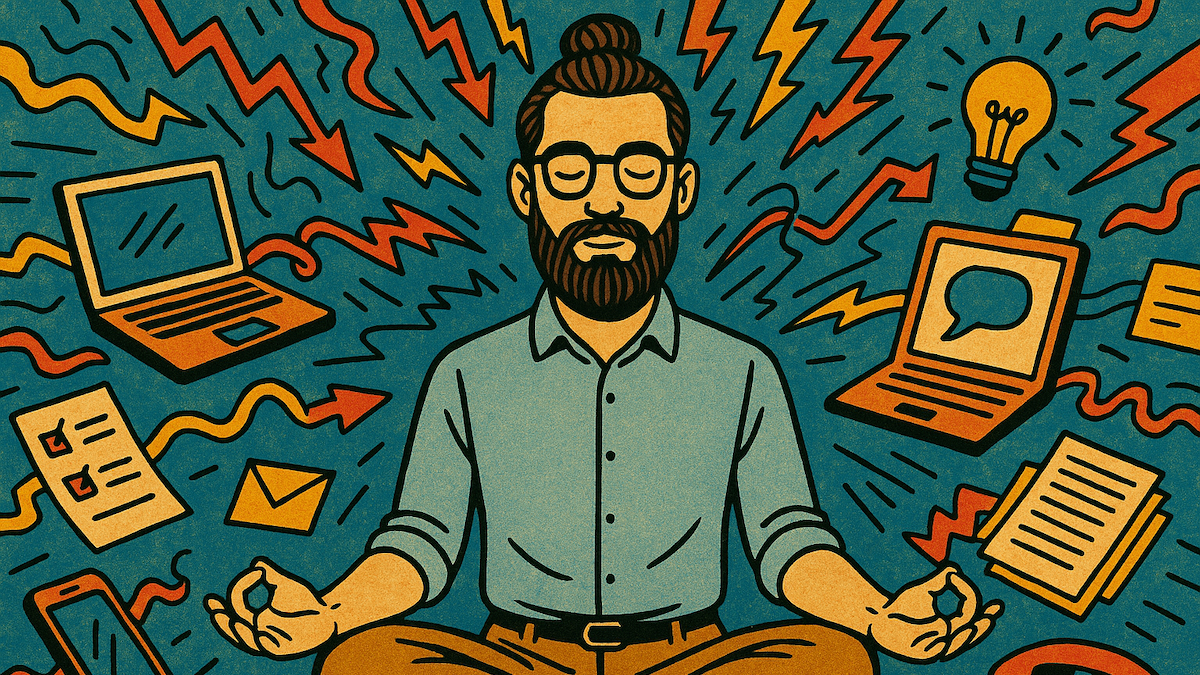
Have you ever wrapped up a full day of productive work and suddenly felt as if you didn’t actually do anything? During those evening hours when you’re supposed to be unwinding, spending time with your family, catching up with friends, or enjoying a book, you’re really checking your email. You’re thinking about what else you could be doing and pre-stressing about tomorrow’s to-dos. You might even be saying to yourself right now, “This always happens to me!” and “Is Christopher from Fast Company Mexico reading my mind?” Fortunately, the answer to that last one is no.
Highly productive people are increasingly falling into a condition known as productivity dysmorphia: feeling like they accomplished nothing, even when they objectively did a lot. It’s worth noting that this isn’t an official medical diagnosis, but in my experience, most high performers run into this challenge at different points in their careers. Why does it happen, and what can we do about it? And yes, I have personally dealt with this well-known productivity dysmorphia too.
Without Human Clarity, No AI Will Be Enough
You may be wondering why I’m writing about this if I recently said my upcoming columns would focus on what you need to know to build a career that can thrive and stay less automatable in the age of artificial intelligence (AI). Fair point. Thankfully, this ties in perfectly; in fact, it might be one of the most valuable insights for understanding your own performance right now.
I often tell my students that the only real way to build a strong AI model or system is to be an expert in the domain where it will be applied. If you aren’t an expert and you’re not taking real steps to learn more about that field, the odds of failure skyrocket. It may sound obvious, but it never stops surprising me how many brilliant leaders, from academia to the world’s largest companies, overlook something so basic.
The same applies to anyone trying to build a career that’s harder to automate in this era of AI: we all need to be experts in how our career, mind, and personality actually work before trying to apply AI to any of it. In other words, it’s essential to understand your real level of productivity compared with what you need to accomplish in your business, career, or goals. Only then can you clearly measure how much AI helps you and how easily it allows you to reach what you’re aiming for.
Understanding your true level of productivity also makes it easier to see, without idealizing, the hyperproductive people you scroll past on LinkedIn, Instagram, TikTok, or any other platform. Comparing ourselves is natural, but without thoughtful reflection, we can misinterpret what we’re seeing or what we’re trying to learn. Sometimes, it even sparks or worsens productivity dysmorphia. You end up sadder, less fulfilled, but supposedly “more productive.” Yeah… no thanks.
Three Steps to Start Measuring What Actually Matters
So the inevitable question is: what can we do? Especially if you suspect you’re dealing with some version of productivity dysmorphia. There are three key steps I’ve used over the years that have been surprisingly helpful for me and for others trying to adapt thoughtfully to AI while pursuing excellence.
First, define clearly what you expect to achieve with AI. Are you trying to be better, faster, or at the level of the best in the world? Your answer gives you your first benchmark.
Second, set clear and measurable expectations. Once you know what you’re optimizing for, you can establish reasonable targets you can actually evaluate. For example, if your goal is to be faster, time yourself without AI and then set your ideal time using AI as support.
Third, review monthly for expectation drift. Just because you wrote something down doesn’t mean your standards won’t quietly inflate as the weeks go by. Seriously, make sure you’re tracking your progress in a methodical way.
There’s no doubt that AI is an extraordinary tool that can boost your productivity and take your career to the next level. But none of that matters if you’re miserable along the way or if you don’t even know how much you’re actually accomplishing, with and without AI, from the start. In a moment when it feels like everyone knows everything about everything, we can’t forget the most important part: knowing ourselves.
Originally published in Spanish for Fast Company Mexico:
https://fastcompany.mx/2025/12/09/productividad-en-la-era-de-la-ia-empieza-por-ti-no-por-el-modelo/